A free one-page formula and 12 before and after briefs that turn generic AI answers into specific ones.
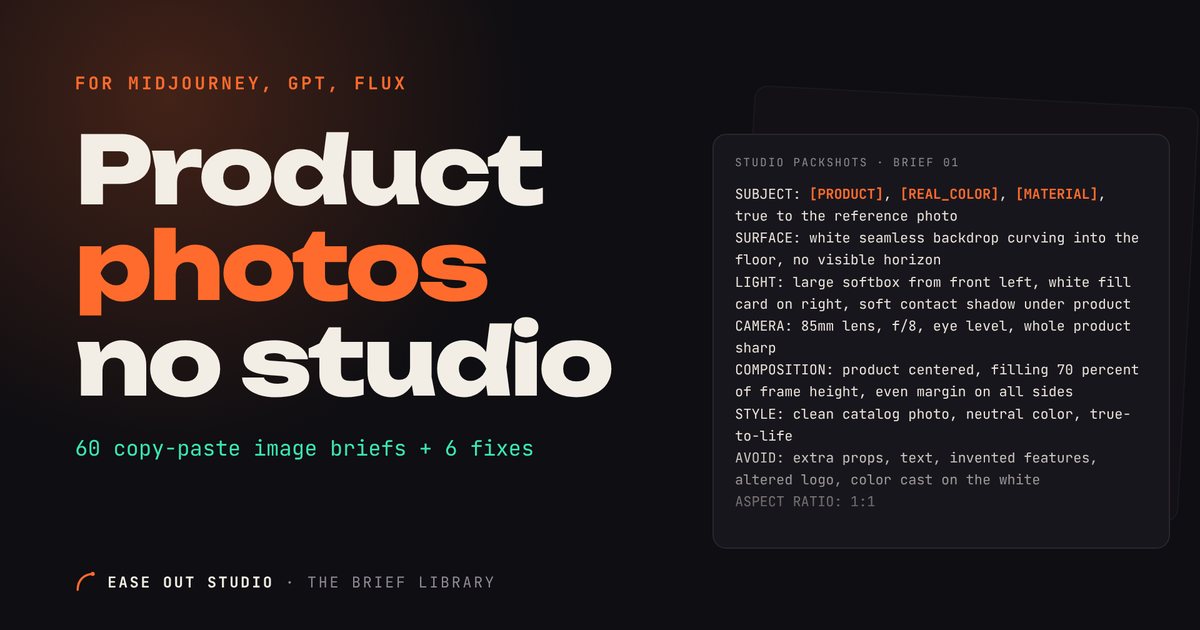
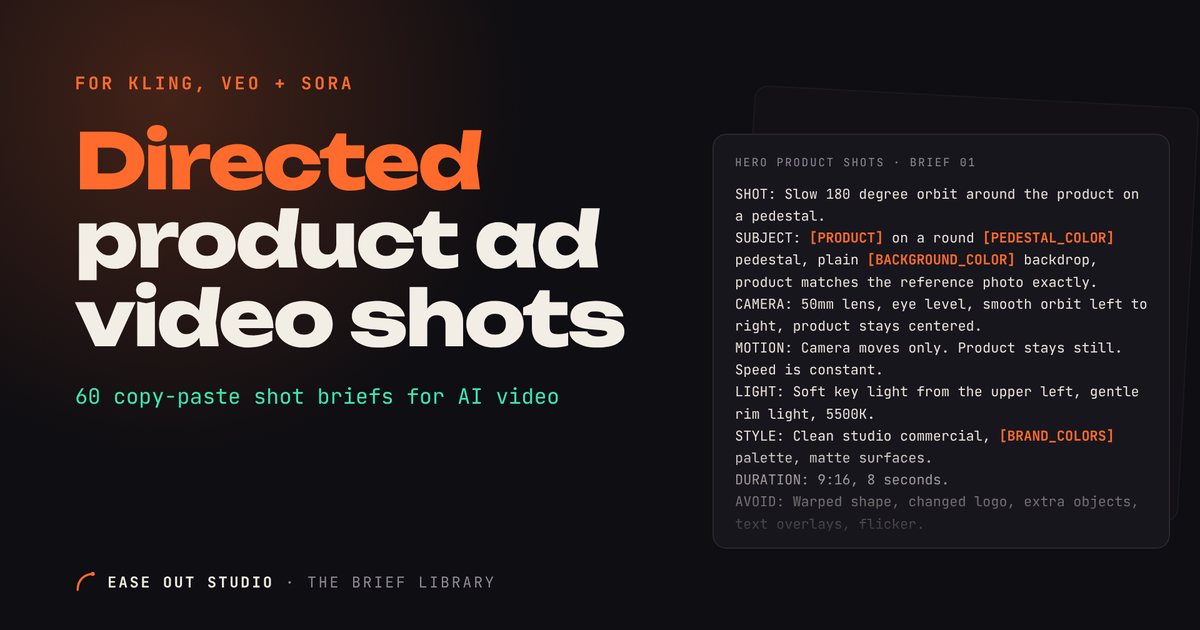
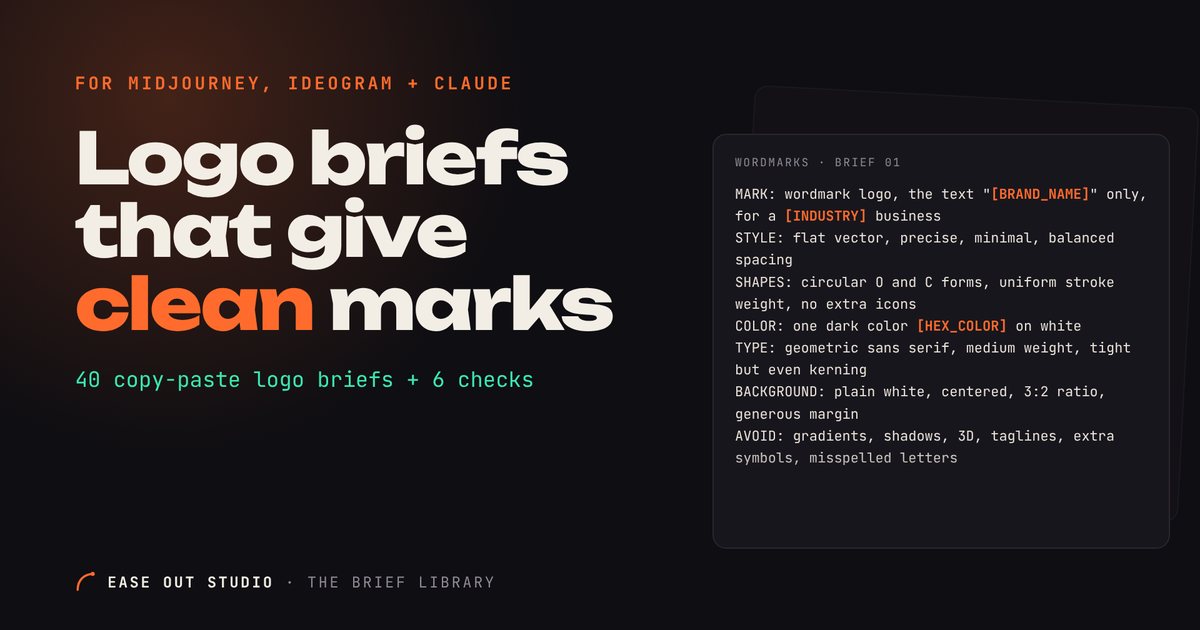
Most generic AI answers come from generic prompts. This free cheat sheet gives you the five-part Brief Formula (ROLE, CONTEXT, TASK, CONSTRAINTS, OUTPUT) and shows it on 12 everyday jobs. It is the free starter for the Brief Library. The paid packs apply the same formula to specific jobs: landing pages, product photos, video ads, Shorts scripts, Claude Code and more.
Works with: Claude, ChatGPT, Gemini and any chat AI
Use the same structure every time. Every brief in this pack follows it (The Brief Formula):
ROLE
Tells the AI who to act as so it answers with the right expertise and point of view. Rule: name a job, not a vague adjective.
CONTEXT
Gives the facts about you, your audience and the situation that the AI cannot guess. Rule: paste real details, never assume it knows them.
TASK
States the one thing you want done, using a clear action verb. Rule: one task per brief.
CONSTRAINTS
Sets the limits: length, tone, what to avoid and what to never invent. Rule: use numbers instead of adjectives.
OUTPUT
Describes the exact shape of the answer so you can use it without reformatting. Rule: name the format and how many options you want.
8 free before and after prompt briefs
Copy a brief, replace every [PLACEHOLDER] with your details and paste it into your AI tool.
Client email
Instead of: "Write an email to my client about the delay."
ROLE: You are a senior account manager who writes calm, direct client emails.
CONTEXT: I run [BUSINESS_TYPE]. My client [CLIENT_NAME] expected [DELIVERABLE] on [ORIGINAL_DATE]. It will now arrive on [NEW_DATE] because [REASON]. Our relationship so far: [RELATIONSHIP_NOTES].
TASK: Write an email that explains the delay, takes responsibility and confirms the new date.
CONSTRAINTS: 120 to 160 words. One apology only. Do not blame third parties. Do not promise anything beyond [NEW_DATE]. Plain US English, no corporate filler.
OUTPUT: 2 subject line options, then the email body ready to send.
Tip: The brief supplies the dates, the reason and the word limit, so the AI has nothing to pad or invent.
Landing page hero copy
Instead of: "Write a headline for my landing page."
ROLE: You are a conversion copywriter who works with small businesses.
CONTEXT: Product: [PRODUCT_NAME], [ONE_LINE_DESCRIPTION]. Audience: [AUDIENCE]. Their main problem: [PROBLEM]. Real proof I can show: [REAL_PROOF_OR_NONE].
TASK: Write the hero section copy for the top of the page.
CONSTRAINTS: Headline max 10 words. Subhead max 25 words. Button label max 4 words. No invented numbers, reviews, scarcity or urgency. Use only the proof listed above.
OUTPUT: 3 options as a numbered list. Each option has a headline, a subhead and a button label.
Tip: Hard word limits and a ban on invented proof keep the copy short and honest.
Product description
Instead of: "Write a product description for my candle."
ROLE: You are an ecommerce copywriter who writes clear, sensory product pages.
CONTEXT: Product: [PRODUCT_NAME] from [BRAND_NAME]. Materials: [MATERIALS]. Size: [SIZE]. Typical buyer: [BUYER]. Facts you may use: [FACT_LIST].
TASK: Write the product page description.
CONSTRAINTS: 90 to 120 words. Use only the facts listed. No health claims and no claims about results. Sentences under 20 words.
OUTPUT: A title under 60 characters, one description paragraph, then 3 bullet points of 8 words or fewer.
Tip: Limiting the AI to a fact list stops it from making up features.
30-second video script
Instead of: "Write a video script for my product."
ROLE: You are a short-form video scriptwriter.
CONTEXT: Product: [PRODUCT_NAME] for [AUDIENCE]. Platform: [PLATFORM], vertical 9:16. Key message: [KEY_MESSAGE]. Footage I can actually shoot: [AVAILABLE_FOOTAGE].
TASK: Script one 30-second video.
CONSTRAINTS: 70 to 85 spoken words. A hook in the first 3 seconds. 5 to 6 shots. One call to action: [CTA]. No claims I cannot back up.
OUTPUT: A table with 3 columns: Time, Visual, Voiceover.
Tip: Word count, shot count and available footage make the script something you can film, not just read.
Logo concept
Instead of: "Give me a logo idea for my bakery."
ROLE: You are a brand identity designer.
CONTEXT: Business: [BUSINESS_NAME], which [WHAT_IT_DOES]. Customers: [CUSTOMER]. Feel in 3 words: [THREE_WORDS]. Where the logo will appear: [PLACES]. Clichés to avoid: [CLICHES_TO_AVOID].
TASK: Propose 4 distinct logo concepts I can hand to a designer or describe to an image tool.
CONSTRAINTS: Max 2 colors plus white. Must stay readable at 32 px and in one color. No gradients. Wordmarks of 2 words or fewer.
OUTPUT: For each concept: a name, a 2-sentence description, hex codes, a typeface style and one risk.
Tip: Size, color and cliché limits force four different directions instead of four versions of the same idea.
Bug fix request
Instead of: "My code doesn't work, fix it."
ROLE: You are a senior [LANGUAGE] developer doing a code review.
CONTEXT: Running [LANGUAGE] [VERSION] on [ENVIRONMENT]. Expected behavior: [EXPECTED]. Actual behavior and exact error: [ACTUAL_AND_ERROR]. What I already tried: [ATTEMPTS]. Code: [PASTE_CODE]
TASK: Find the root cause and fix it.
CONSTRAINTS: Change as few lines as possible. Do not rename functions or add libraries. If you need more information, ask up to 3 questions before answering. Say what you are unsure about.
OUTPUT: 1) The cause in 2 sentences max. 2) Only the changed code. 3) One test I can run to confirm the fix.
Tip: Expected versus actual behavior plus a minimal-change rule gets a targeted fix instead of a rewrite.
LinkedIn post
Instead of: "Write a LinkedIn post about my new project."
ROLE: You are a ghostwriter for a [JOB_TITLE] who writes plainly and avoids buzzwords.
CONTEXT: Project: [PROJECT_NAME]. What really happened: [REAL_EVENTS]. The lesson: [LESSON]. Audience: [AUDIENCE]. A sample of my own writing: [PASTE_100_WORDS].
TASK: Write one post in my voice.
CONSTRAINTS: 150 to 200 words. First line under 12 words. Max 3 hashtags. No invented numbers, clients or quotes. No phrases like "excited to announce".
OUTPUT: 2 versions labeled A and B, post text only.
Tip: A real voice sample and real events are what separate your post from the generic one.
Meeting notes summary
Instead of: "Summarize these meeting notes."
ROLE: You are a chief of staff who writes tight meeting recaps.
CONTEXT: Meeting: [MEETING_NAME] on [DATE]. Attendees: [NAMES]. Readers: [READERS], who did not attend. Notes: [PASTE_NOTES]
TASK: Summarize the decisions, action items and open questions.
CONSTRAINTS: Max 200 words total. Every action item needs an owner and a due date. If either is missing, write "unassigned" or "no date" and do not guess. Use only what is in the notes.
OUTPUT: Three headed sections: Decisions, Action items (a table with Owner, Task, Due) and Open questions.
Tip: Telling the AI what to write when information is missing prevents invented owners and deadlines.
How to use these briefs
Read the five parts of the Brief Formula once. Each one is a single line in your prompt.
Pick the job closest to yours in Before and after and copy the brief.
Replace every [PLACEHOLDER] with your real details. Delete any line you cannot fill in rather than guessing.
Paste it into Claude, ChatGPT, Gemini or any chat AI and read the first answer against your constraints.
If the answer misses, paste a message from Fix-it follow-ups instead of starting over.
Run the 10-question checklist before you hit enter until it becomes a habit.
What you get
Free AI Prompt Cheat Sheet: The Brief Formula for Claude & ChatGPT
Before and after: 12 briefs. Twelve everyday jobs, each shown as the bare prompt most people type and the directed brief that replaces it. Fill in the placeholders and paste.
Fix-it follow-ups: 8. When the first answer misses, paste one of these instead of rewriting your whole prompt.
Before you hit enter: 10. Ten questions to ask yourself before you send any prompt.
Format: instant download, a PDF, a page with a Copy button for every brief and a plain text file
Give the model the same parts every time: ROLE, CONTEXT, TASK, CONSTRAINTS, OUTPUT. Fill each part with specifics such as sizes, timings, counts and what to avoid, instead of adjectives. The free briefs on this page show the full structure filled in.
Which AI tools does it work with?
It works with Claude, ChatGPT, Gemini and any chat AI. The briefs are plain text, so you paste them into whichever tool you use.
What format do I get?
An instant download with a PDF, a copy-button page and a plain text file. Use the PDF to read, the copy-button page to paste fast and the text file to keep your own edited versions.
Will this stop the AI from getting facts wrong?
No brief can promise that. The formula lowers the chance of invented details by giving real facts and telling the AI not to guess, but you should still check names, numbers and claims before you use the result.
Is it really free, and is it the same as the paid packs?
Yes, the cheat sheet is free. It teaches the formula on 12 general jobs. The paid packs are separate and apply the same formula to specific jobs in more depth.